Product description
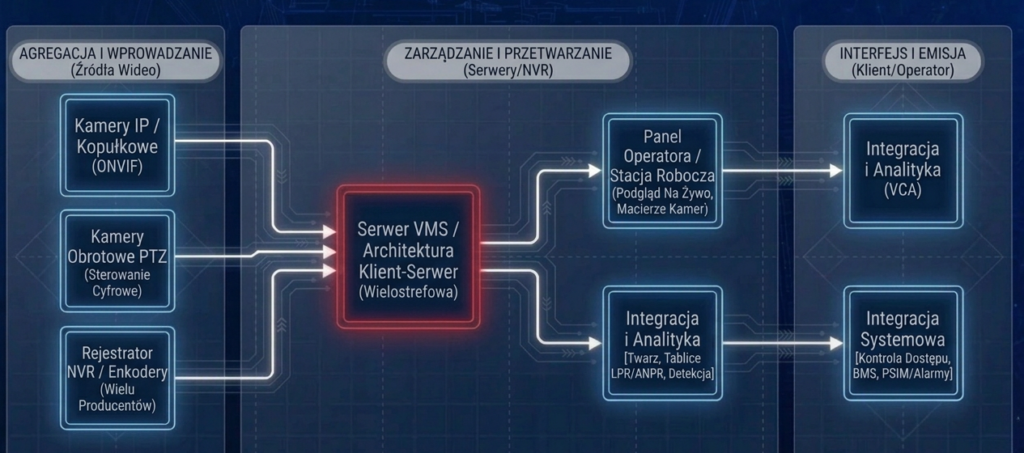
VMS (Video Management Software) is software that constitutes the central element of a video surveillance system based on IP cameras. Its basic task is the aggregation and management of video streams from many cameras and recorders (NVR), regardless of whether they operate in a single location or are dispersed across many facilities connected by an IP network. VMS acts as an intermediary between the hardware layer (cameras, encoders, disk arrays) and the operator, providing a coherent interface for operating the entire surveillance infrastructure.
The basic functions of the system include live preview with the ability to build any video layouts (camera matrices), digital control of PTZ pan-tilt-zoom cameras, and the searching and playback of archived recordings — by time, event, motion in the frame or specific camera. The software also allows the flexible configuration of recording schedules (continuous, on motion detection, alarm-triggered, in time windows), the management of data retention and archiving, and, in advanced deployments, the replication and redundancy of recordings between servers.
An important part of the functionality of modern VMS systems is integration with video analytics (VCA — Video Content Analytics), including motion and intruder detection, line crossing or entry into a prohibited zone, people counting, licence plate recognition (LPR/ANPR), face recognition or the detection of left-behind or removed objects. This analytics can run both on the camera side (edge) and on the VMS server, generating events and alarms visible directly in the operator interface.
VMS is usually designed as a platform open to integration with other security systems — access control, intruder and hold-up alarm systems, PSIM or BMS systems — so that an event from another subsystem (e.g. the opening of an emergency door) can automatically call up a view from an associated camera. The management of users, roles and access permissions to individual cameras and functions, operation in a client-server architecture or in the cloud (VSaaS), as well as support for many hardware manufacturers via the ONVIF standard, complete the picture of the system as a central tool for managing a facility’s visual security.